Payroll
Payroll That Doesn't Stand Apart From the Rest of Your Business.
Payroll here isn't a separate account with a separate login and a separate support queue. It's processed reliably, on schedule, and connected to the same books, tax filings, and financial decisions EFS already handles.
When Payroll Turns Into Its Own Isolated System
Payroll can be running perfectly and still leave a financial blind spot. When payroll, bookkeeping, taxes, and financial planning live separately, no one may be looking at how a payroll decision affects the whole business.
The problem isn't that payroll doesn't work. It's that payroll doesn't see the rest of the business.
Payroll decisions affect more than a paycheck. Labor costs can influence taxes, cash flow, bookkeeping, and the financial decisions a business makes next.
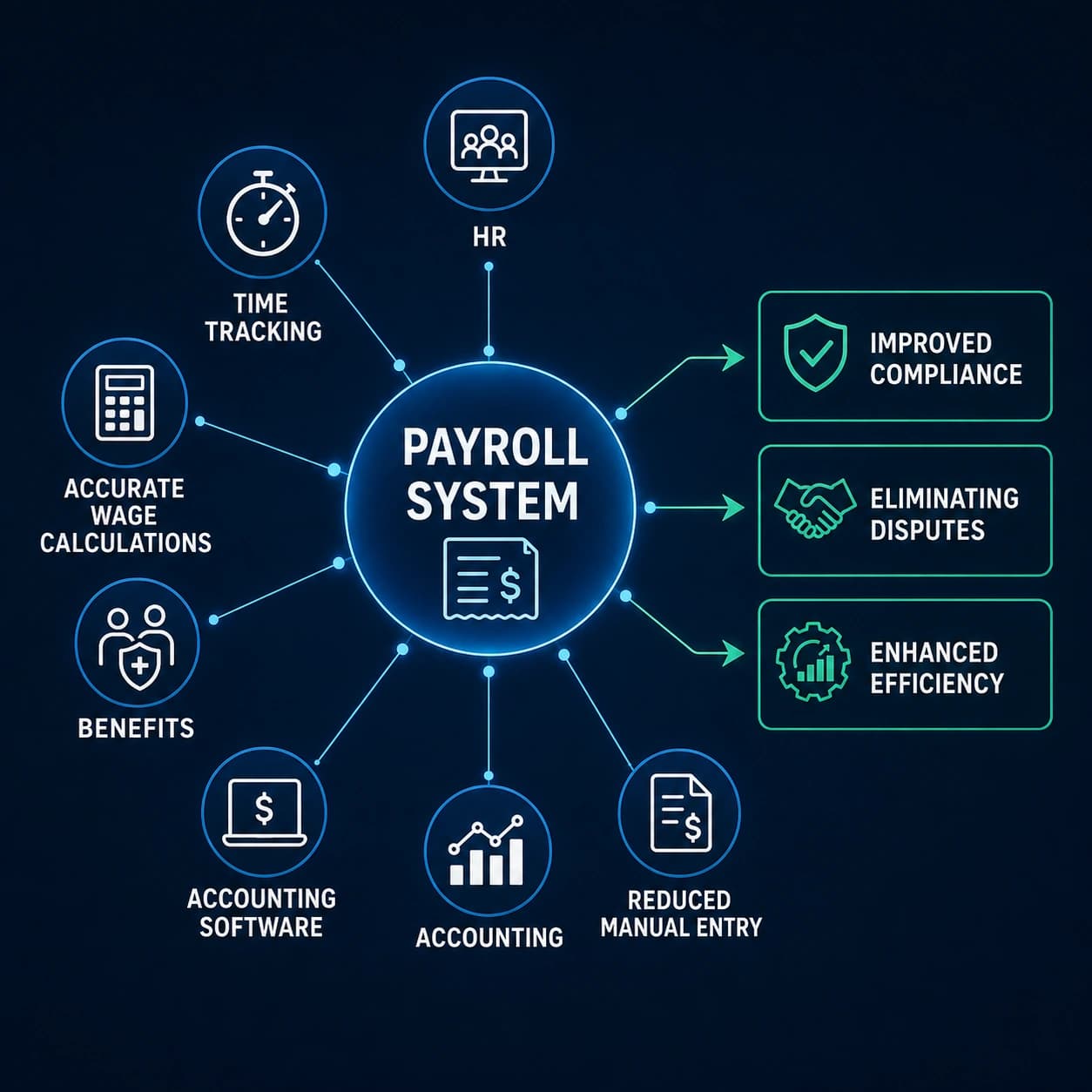
Payroll decisions can touch:
- Employee time & compensation
- Employer taxes
- Benefits & labor costs
- Accounting & cash flow
- Financial planning
See what happens when…
PayrollTaxesCashFinancial Forecast
A $70,000 salary isn't a $70,000 business decision.
Illustrative example, not an EFS client figure.
The salary is only one part of the employer's cost. Payroll taxes, benefits, workers' compensation, and other employer costs can change what the hire actually means for cash flow and the business's financial plan.
One paycheck can touch more than payroll.
For an S corporation owner, compensation affects payroll records, bookkeeping, and tax planning. Looking at those pieces together provides more context than treating the payroll run as an isolated transaction.
Learn about S-Corp reasonable compensationTechnology Runs the Process. People Understand the Business.
Technology Handles
- Calculating pay, withholdings, and deductions consistently, run after run
- Keeping records organized and available
- Processing on the same schedule every pay period
- Reducing the manual, repeatable parts of the work where errors tend to creep in
Your EFS Relationship Brings
- Context — because the people running payroll already know your books
- A real answer when something looks off, not a ticket number
- Judgment on exceptions: a new hire, a raise, a bonus, a departing employee
- A view of how a payroll decision affects the rest of the business's numbers
The goal isn't technology instead of people, or people instead of technology. It's technology doing the repeatable work reliably, so the people already familiar with your business can spend their attention on the parts that actually need judgment.
Who This Is For
This is built for established employers with real payroll to run — LLCs, S corporations, C corporations, and partnerships with employees — across industries. It's relevant the moment a business has its first employee and stays relevant as headcount, pay structures, and complexity grow. Construction businesses managing crews are a common example, but this isn't limited to any one industry.
Construction Payroll's Real Complexity
Payroll for a construction business rarely looks like payroll for a standard office. When crews move between jobs, a single weekly payroll run still has to tell each project what its share actually cost.
This Week's Field Payroll
$86,420
Project 101
Apartment Renovation
$31,240
36% of payroll
Project 104
Commercial TI
$37,680
44% of payroll
Project 109
Custom Home
$17,500
20% of payroll
96 hours · 3 projects · labor allocated where the work happened
Illustrative example only.
Your payroll total is one number. Your projects need to know their share of it.
When employees work across multiple jobs, labor costs need to follow the work. Accurate time and payroll allocation helps project-level reporting reflect where labor was actually used.
Carlos R. — 48 Hours
- Project 10118 hrs$720
- Project 10422 hrs$880
- Project 1098 hrs$320
Project labor cost can include more than gross wages — employer payroll taxes and other employer labor costs are part of the total.
Total labor cost allocated to each job
Illustrative example only, not an EFS client figure.
Payroll vs. Budget by Project
Illustrative example only.
To be direct about scope: this service does not currently include certified payroll reporting, prevailing-wage compliance, union payroll administration, or job-costing software integration. If a project specifically requires one of those, that's worth a direct conversation before assuming it's covered.
For a broader look at how payroll fits into the rest of a construction company's finances — job costing, WIP, margin — see EFS's work with construction companies.
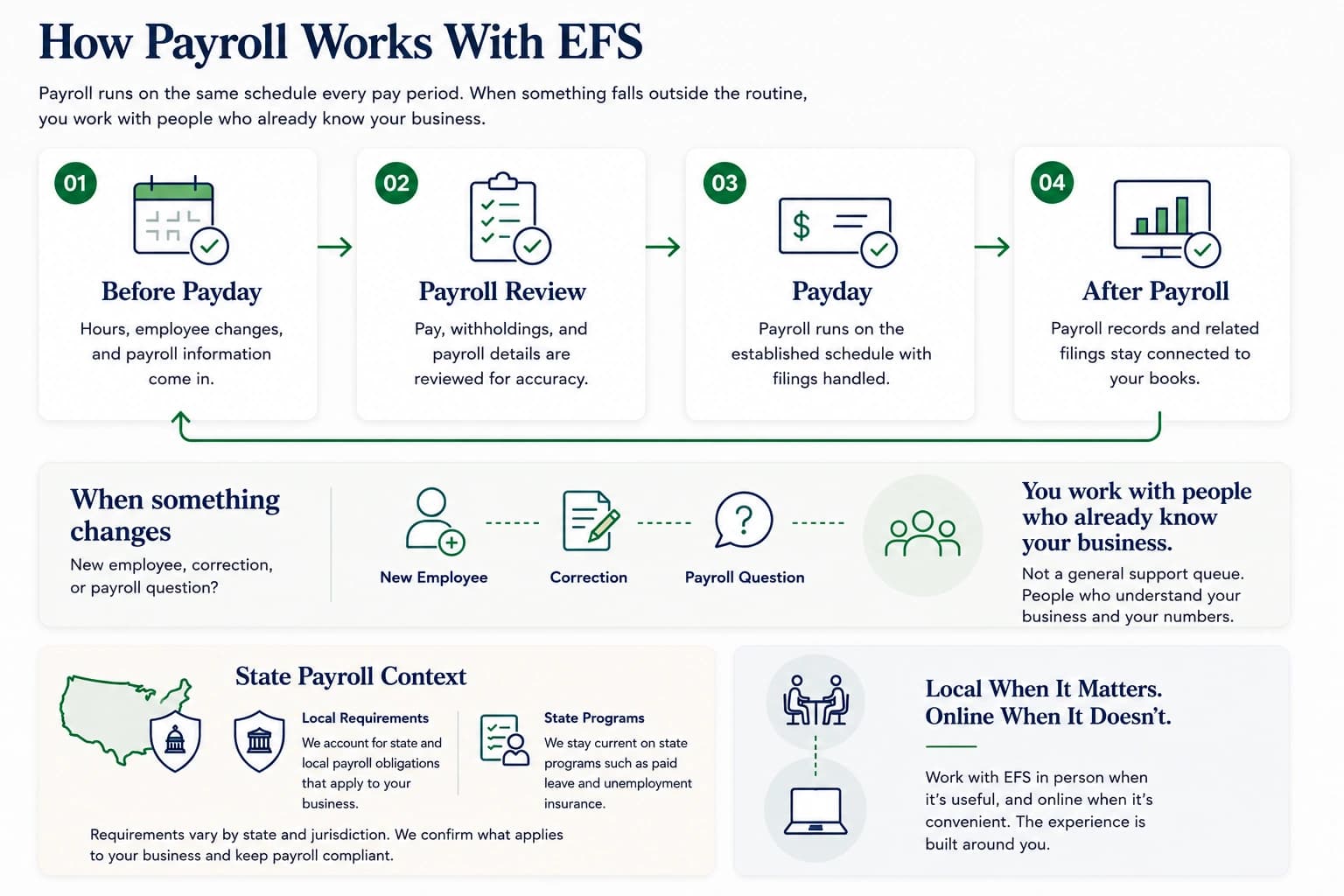
How Payroll Works With EFS
Payroll follows a consistent schedule each pay period, while changes and questions are handled by people who already know your business.
01
Before Payday
Hours, employee changes, and payroll information come in.
02
Payroll Review
Pay, withholdings, and payroll details are reviewed for accuracy.
03
Payday
Payroll runs on the established schedule with related filings handled.
04
After Payroll
Payroll records and related filings stay connected to your books.
When something changes
New EmployeeCorrectionPayroll QuestionPeople who know your business
Not a general support queue. You work with people who understand your business and your numbers.
State Payroll Context
Payroll requirements can vary by state and jurisdiction, so the setup should reflect what applies to the business.
Local When It Matters. Online When It Doesn't.
Work with EFS in person when it's useful and online when it's convenient.
Changing Payroll Providers Without the Disruption
Switching payroll providers is a reasonable thing to consider, and it doesn't have to happen in the middle of a mess. Yes — payroll providers can typically be changed at a natural point in the year, most commonly at a quarter or year boundary to keep tax filings clean, though a mid-year change can also be managed with the right records in hand. Payroll history doesn't disappear; prior records and year-to-date totals carry forward so an employee's annual totals stay accurate. Before switching, it's worth reviewing the current provider's cutoff dates, what records they'll release, and how upcoming pay dates line up with the transition.
What's Typically Needed to Switch
- Recent payroll registers and year-to-date totals for each employee
- Employee information already on file (W-4s, direct deposit details)
- Prior payroll tax filings for the current year
- The current pay schedule and any upcoming pay dates
The goal is for switching to feel organized, not disruptive — with a clear sense of what's needed and when the change actually takes effect, confirmed directly for your situation.
Pricing
Payroll is typically priced around employee count and pay frequency, and structured alongside whatever other EFS services are already part of the relationship, rather than as an isolated, standalone quote. See EFS's broader pricing structure for how that fits together.
Common Questions
What payroll services does EFS provide?
EFS processes payroll correctly and on schedule, along with the withholdings and filings that come with it, as part of the same relationship that can also include bookkeeping, tax preparation, tax strategy, and CFO-level guidance.
Who are EFS's payroll services for?
Established employers with real payroll to run — LLCs, S corporations, C corporations, and partnerships with employees — across industries, including construction businesses managing crews.
How does payroll work with EFS?
Payroll processes on a consistent schedule each pay period. Technology handles the calculations and repeatable workflow; the people already familiar with your business handle exceptions, questions, and anything that connects to a bigger financial decision.
Does EFS handle payroll taxes?
Payroll withholdings and the filings that go with them are part of the service, alongside processing itself. Specific tax responsibilities for your business are confirmed directly as part of setting up the engagement.
How is EFS different from payroll software alone?
Software processes whatever numbers it's given. It has no way to know whether a raise makes sense for the business, why overtime spiked on a specific job, or how a new hire affects the year's tax picture. EFS pairs the processing with people who already understand your books and can connect payroll to those bigger questions.
How is EFS different from a national payroll provider?
A national payroll provider's support is a queue — a different person, starting from zero, every time you call. At EFS, payroll is handled by the same financial relationship that already knows your business, not a separate account with its own support line.
Can EFS handle payroll and bookkeeping together?
Yes. Payroll and bookkeeping are commonly part of the same engagement, which means payroll data reconciles with the books as a normal part of the relationship rather than a separate reconciliation project.
How does payroll connect with tax planning?
Payroll decisions — compensation, timing, structure — have real tax consequences, and tax strategy decisions can affect payroll in return. Handling both inside the same relationship means those decisions get made with the connection in mind, rather than discovered after the fact at filing time.
Does EFS provide payroll services for construction companies?
Yes, with a real understanding of what makes construction payroll harder — shifting crews, job-level labor costs, overtime, and reconciling payroll with the books. This service does not currently include certified payroll reporting, prevailing-wage compliance, or union payroll administration; a project that specifically requires those is worth a direct conversation first.
Where does EFS provide payroll services?
EFS is based in Wheat Ridge, Colorado, and works with business owners across the Denver Metro area, Aurora, Colorado Springs, and Northern Colorado.
Ready for Payroll That's Actually Connected?
A short conversation is enough to understand what your business needs from payroll, and how closely it should connect to the rest of your financial picture.