











Accounting & Bookkeeping
Know Where Your Business Stands.
Reliable accounting and bookkeeping give you more than clean records. They give you a financial picture you can actually use.
You Keep Running the Business.
We'll Keep the Financial Picture Clear.
From bookkeeping and taxes to bigger financial decisions, we're here to help you understand what comes next.
Who This Is For
This work is built for established, growing businesses rather than a brand-new side venture — construction companies, real estate businesses, and other owner-led companies that have reached the point where the books need to be dependable, not just done. Many of the businesses EFS works with are approaching or past several million dollars in revenue, though that's a general pattern rather than a hard requirement.

What We Handle for Your Books
Monthly bookkeeping and reconciliations
so the numbers reflect what's actually happening, not what happened two months ago.
Financial statements built to be read, not just filed
so you can see the business, not just a ledger.
Payroll coordination and year-end readiness
so neither one becomes a scramble.
Cleanup and catch-up work, and the groundwork tax preparation depends on
so a rough start doesn't stay a permanent handicap.
Accurate books are the foundation. Not the end goal.
More Than Bookkeeping
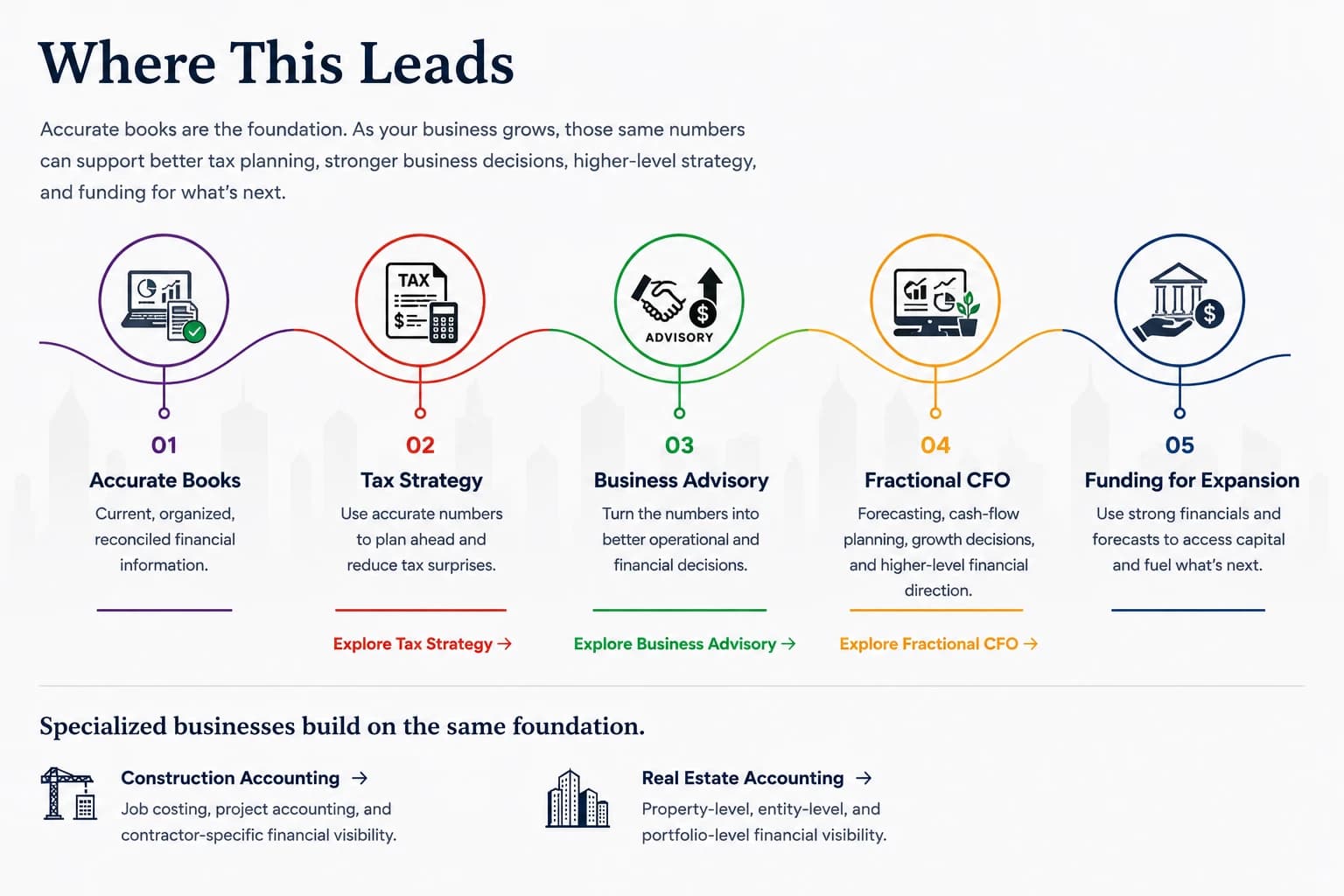
Basic bookkeeping tells you what happened. Once the numbers are current and trustworthy, they can also tell you why something moved, what deserves attention, and what to do next — which is the foundation tax strategy, business advisory, and fractional CFO work are all built on.
1Record Transactions
Bank activity, invoices, receipts, and payroll are captured from every source.
2Organize & Classify
Each transaction is coded to the right account, not just entered.
3Review & Verify
Records are reviewed for accuracy, consistency, and proper treatment.
4Reconcile & Balance
Accounts are tied out against bank and statement records, and discrepancies are identified.
5Maintain & Monitor
The books stay current and organized as the business operates — ready for reporting and tax preparation, not revisited once a year.
What You Gain

Complete & Reliable
Every transaction is recorded and organized the right way.

Accurate by Design
Your books are reviewed and verified using consistent accounting practices.

Clear & Trusted
You can see exactly where things stand, whenever you need to.

Ready for What's Next
Your books are current and organized — ready for reporting, tax preparation, and growth.

Confidence in Your Numbers
A dependable foundation to run and grow your business on.


01
Accurate Books
Current, organized, reconciled financial information — the foundation everything else builds on.


04
Fractional CFOForecasting, cash-flow planning, growth decisions, and higher-level financial direction.
Explore
05
Funding for Expansion
Use strong financials and forecasts to access capital and fuel what's next.
Pricing
Accounting engagements are structured around the complexity of the business — transaction volume, number of accounts or entities, and how much cleanup work is involved.
Cleanup and catch-up work is quoted after a short assessment.
Common Questions
How often should my books be updated?
Monthly, at minimum, for most businesses — that's often enough to catch issues while they're still small. Businesses with higher transaction volume or multiple entities usually benefit from more frequent updates, so decisions are never based on numbers that are months old.
How far behind can bookkeeping get before it becomes a problem?
Even a few weeks behind can make it harder to see where the business stands. Once bookkeeping falls several months behind, decisions may start getting made on memory or a bank balance instead of current numbers — and errors can become harder to identify and correct. There's no universal cutoff, but if you can't confidently explain what the business earned, spent, or owes from the previous month, it's a good signal that the books need attention.
What is the difference between bookkeeping and accounting?
Bookkeeping is the ongoing recording and categorization of transactions. Accounting includes that, plus the reconciliations, financial statements, and judgment calls that turn those transactions into something you can actually use to understand the business. EFS provides both together rather than treating them as separate services.
Why doesn't my bank balance tell me whether my business is profitable?
Your bank balance shows how much cash is sitting in an account right now — it doesn't show profitability, outstanding bills, receivables you haven't collected, or payroll and taxes you owe but haven't paid yet. A business can have a healthy balance and still be unprofitable, or a tight balance and still be doing well. Financial statements built from accurate books are what actually show the difference.
Why don't I trust my financial reports even when my bookkeeping is done?
Usually because the numbers were entered inconsistently — the same type of expense categorized differently from month to month, or transactions coded to whatever account was fastest instead of what was accurate. Reports built on inconsistent categorization can be complete and still misleading, which is different from reports that are simply late. Consistent categorization, applied the same way every month, is what makes reports something you can actually rely on.
Can EFS clean up books that are behind?
Yes — cleanup and catch-up work is a normal starting point, not a barrier to entry. It's scoped the same way described above, based on how far behind things are and how many accounts are involved.
When does a growing business need more than bookkeeping?
Usually when a specific decision is on the table — financing, a major hire, adding an entity, or preparing for a sale — and the business needs someone thinking through the numbers, not just recording them. That's typically when business advisory, tax strategy, or fractional CFO support starts to matter. EFS walks through that question in more depth in a resource on when a business needs more than bookkeeping.
How does bookkeeping connect to tax planning?
Clean, current books are what make proactive tax planning possible in the first place. Decisions around entity structure, timing, and deductions depend on knowing where the business actually stands throughout the year, not just reconstructing it at filing time.
Why does tax season turn into bookkeeping cleanup every year?
Usually because the books weren't kept current the rest of the year, so transactions have to be reviewed, corrected, and categorized properly before a return can even be prepared. That cleanup work is what turns filing into a scramble instead of a straightforward process. Keeping the books current throughout the year is what keeps tax season from becoming a second, unplanned project. EFS's tax preparation work covers what filing looks like once the books are ready.
Ready to Get a Clear Picture of Your Numbers?
A short conversation is enough to understand where things stand and what it would take to get the books current and dependable.